Euro
Euro
 British Pound



Product Description
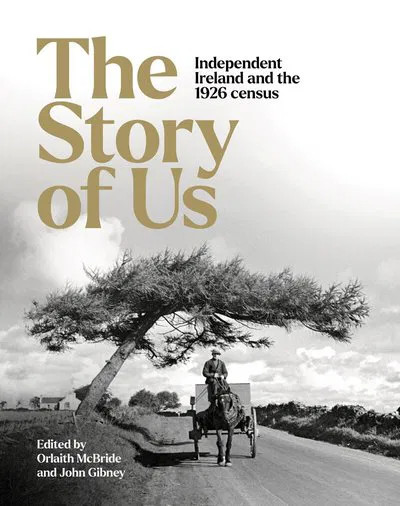
On 1 ͅ April 1926 the first census of an independent Irish state was
undertaken. Across the 26 counties over 700,000 census forms were
completed by, or on behalf of, the 2,971,992 people living in the Irish ree
State. But what can we know of the lives that they ledǫ
A century later, with the release of the 1926 census by the National
Archives on 1 ͅ April 2026, those forms come alive again - revealing a
nation in transition and a people forging their identity in the early decades
of independence. The Story of Us brings together an wide range of scholars
to illuminate the individuals and communities hidden within the census
returns. rom island settlements to expanding cities, from rural farms
and urban tenements to the mansions of the aristocracy, the book traces
a vibrant cross-section of society. avishly illustrated, it explores themes
ranging from entertainment and the arts to housing, infrastructure, family
life, and social change.
The Story of Us offers not only a compelling portrait of 1926 Ireland but a
deeper understanding of the world in which these lives unfolded.
ABOUT THE EDITORS: Orlaith McBride has been Director of the National Archives/An Chartlann Nisiïnta since April 2020. She previously served as Director of the Arts Council/An Chomhairle Éalion, where she led maor national
initiatives including the 2016 commemorations programme. arlier in her career, she worked widely across the arts sector. She has served on Dublin City University’s Governing Authority and is a member of the Brian Friel Trust.
John Gibney is Assistant ditor with the Royal Irish Academy’s Documents on Irish Foreign Policy programme. He has written widely on Irish history and historiography. His books include A short history of Ireland and he was one of the co-curators of the maor international exhibitions presented by the National Archives in partnership with the RIA to mark the centenaries of both the Anglo-Irish Treaty of 1921 and Irish membership of the League of Nations in 1923.
Contents -
Table of Contents
1: Days in the life: The weekend of the 1926 census – Gregory Walls
2: Passion and patriotism: Recreation in independent Ireland – Paul Rouse
3: Ireland at a crossroads: Seumas O’Sullivan and The Dublin Magazine – Frank Shovlin
4: Dogged adaptation: Irish architecture in April 1926 – llen Rowley
5: The Irish diaspora in the United States – Mike Cronin
6: The Irish diaspora in Britain – Mo Moulton
7: Creating and analysing the 1926 census – Gregory Walls
8: Names and ages, families and places – Gregory Walls
9: Everyday life: Miltown Malbay, Co. Clare, April 1926 – Anne Dolan
10: The revolutionary generation in the 1926 census – John Gibney and Gregory Walls
11: The 1926 census and the impact of war and revolution – Marie Coleman
12 : From workhouse to county home: St Phelim’s Hospital, Cavan, in 1926 – Georgina Laragy
13: Migration and the 1926 Census – Miriam Nyhan Grey
14: Inward migration in the 1926 census – John Gibney
15: Emigration, return, friendship and war: Headford, Co. Galway – Kate O’Malley
16: The children of Dog's Lane, Galway City – Sarah-Anne Buckley
17: An island family: Gola, Co. Donegal, 1926 – Orlaith McBride
18: Gaeltacht ar fán: Doire Fhinín i 1926 / Barely alive: a ghost Gaeltacht in Muskerry in 1926 – Cormac Ó Gráda
19: Language, politics and religion: Identities in the 1926 Census – Gearóid Ó Tuathaigh
20: Daonáireamh 1926 agus an Ghaeilge/ The 1926 Census and the Irish language – Gearóid Ó Tuathaigh
21: Minority population decline in the south of Ireland between 1911 and 1926 – Andy Bielenberg
22: Gender, dependence and the family economy in the 1926 census: Featherbed Lane, Cork city – Lindsey Earner-Byrne
23: The Anglo-Irish aristocracy in the 1926 census – Terence Dooley
24: Livelihoods and living conditions – Gregory Walls
25: Housing in Ireland, 1926– Ruth McManus
26: 16 Digges Street Upper, Dublin city – Padraig Yeates
27: 34 Marlborough Street, Dublin city – Ida Milne
28: Industrial heritage in the 1926 census – Rob Goodbody
29: Releasing the 1926 census – Jessica Baldwin, Gerard Byrne, Niamh McDonnell, Dáire Rooney