Euro
Euro
 British Pound



Product Description
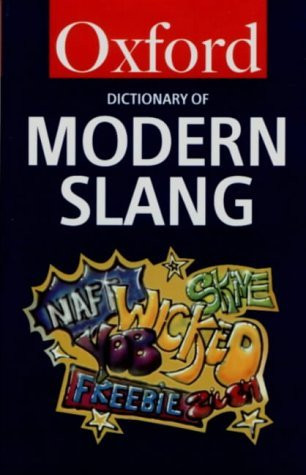
Slang is language with its sleeves rolled up, colorful, pointed, brash, bristling with humor and sometimes with hostility. From "forty-rod whiskey" and "five-finger discount" to "bum rap," "buzz off," and "fly by night," slang words add zest to everyday speech. Now, in The Oxford Dictionary of
Modern Slang , John Simpson and John Ayto have gathered together a vibrant collection of over 5,000 slang terms, drawn from the vast Oxford English Dictionary database.
Each entry contains the headword, part of speech, and definition. The great majority also have at least one illustrative example of the term in context, often drawn from writers such as John Updike, Gore Vidal, Louise Erdrich, Jessica Mitford, and Thomas Pynchon. Many entries contain labels
indicating the social group or discipline from which a word derives--such as Black English, theatrical, military, or nautical--as well as the region where it originated. In addition, when the term has had more than one meaning, the various senses are listed chronologically. The changes in meaning
are often "Slush fund," originally a navy expression, referred to money collected from the sale of "slush" (fat or grease obtained from boiling meat) and used to buy luxuries for the crew. "Snow bird" originally meant someone who joined or rejoined the Army in the winter for food and
shelter. And both "to give someone the bird" and "to goose someone" were theatrical terms meaning "to boo a bad performance." The dating of terms also yields some surprises. "Out-of-sight," for instance, dates to 1896, "buzz off" to 1914, and "blind" (as in "blind drunk") first appeared in print in
1630. (On the other hand, the expression "gussied up," which seems old fashioned, first appeared in 1952). The etymologies are often the word "boondocks," for example, comes from the Tagalog word bundok (mountain), and those who use "poppy-cock" to avoid stronger language will be
saddened to hear that it derives from Dutch dialect pappekak (soft excrement). Finally, the words have been gathered from all over the English-speaking world, including many from Australia--such as "ankle-biter" (child), "blue" (a redhead), "technicolor yawn" (vomiting)--and from the United Kingdom,
such as "blimey" (a contraction of "God blind me") and "Thiefrow" (a nickname for London's Heathrow Airport, after its reputation for lax security).
Ranging from age-old (but still common) slang expressions such as "mamzer" (Hebrew, "bastard") which appeared in English usage as early as 1562, to recent coinages such as "wilding" (a gang of youths on a rampage) which first appeared in 1989, this is an authoritative and up-to-date record of
slang throughout the English-speaking world.
This book is second hand, and while you may not get the same publication/version/reprint/edition shown in the picture it will be the same author and title.
Removing existing stickers from a second hand book may damage it, so we refrain from doing so.
Even if the picture shows no price stickers on the book they may be there on the copy you receive.
All of our books are in very good condition.
Please be aware that there will be a sticker with an identifying number on the spine of this book.