Euro
Euro
 British Pound


Product Description
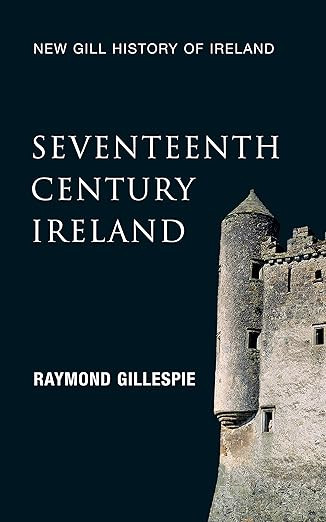
Paperbcak, a standalone book in the New Gill History of Ireland Series, ( Volume 3) first published by Gill in 2006. In very good condition, price sticker from UCD Bookshop on back cover.
Most surveys of seventeenth-century Ireland approach the period using war, conquest, plantation and colonisation as their organising themes. It does not see Ireland as a passive receptor of colonial ideas imposed from above. In fact, Professor Gillespie argues that the seventeenth century was a uniquely creative moment in Ireland's history, as the various social and political groups within the country tried to forge new compromises. He also shows how and why they failed to do so.
Well-established ideas of monarchy, social hierarchy and honour were under pressure in a fast-changing world. Political, religious, social and economic circumstances were all in flux. The common ambition of every faction was the creation of a usable focus of governance. Thus plantations, the constitutional experiments of Wentworth in the 1630s, the Confederation of the 1640s, the republican 1650s and the royalist reaction of the latter part of the century can be seen not simply as episodes in colonial domination but as part of an on-going attempt to find a modus vivendi within Ireland, often compromised by external influences.
This book is not simply a narrative history of politics in seventeenth-century Ireland. It is a social history of governance that, while dealing with the main political, religious and economic developments, has at its interpretative core the process of making a new society out of competing factions.
Seventeenth-Century Ireland: Table of Contents
- Introduction: Seventeenth-Century Ireland and its Questions
Part I. An Old World Made New
- Distributing Power, 1603–20
- Money, Land and Status, 1620–32
- The Challenge to the Old World, 1632–9
Part II. The Breaking of the Old Order
- Destabilising Ireland, 1639–42
- The Quest for a Settlement, 1642–51
- Cromwellian Reconstruction, 1651–9
Part III. A New World Restored
- Winning the Peace, 1659–69
- Good King Charles's Golden Days, 1669–85
- The King Enjoys His Own Again, 1685–91
Epilogue: Post-War Reconstruction, 1691–5